Eleanor Adair, (Agnes) was one of the most influential beauty experts in the early 1900s. She had stores in Paris, London, and New York City. Her unique methods were derived from time in India, fashion school, and having a husband in the Royal Army Medical Corp. She sold her products on every corner of the Earth through mail order reaching as far as Rio de Janeiro, Algeria, and Zagreb. She was widely thought of as one of the earliest science based beauty experts, although now we’d probably see her methods as outdated. Possibly even pseudoscience, although she seemed like an honest person.
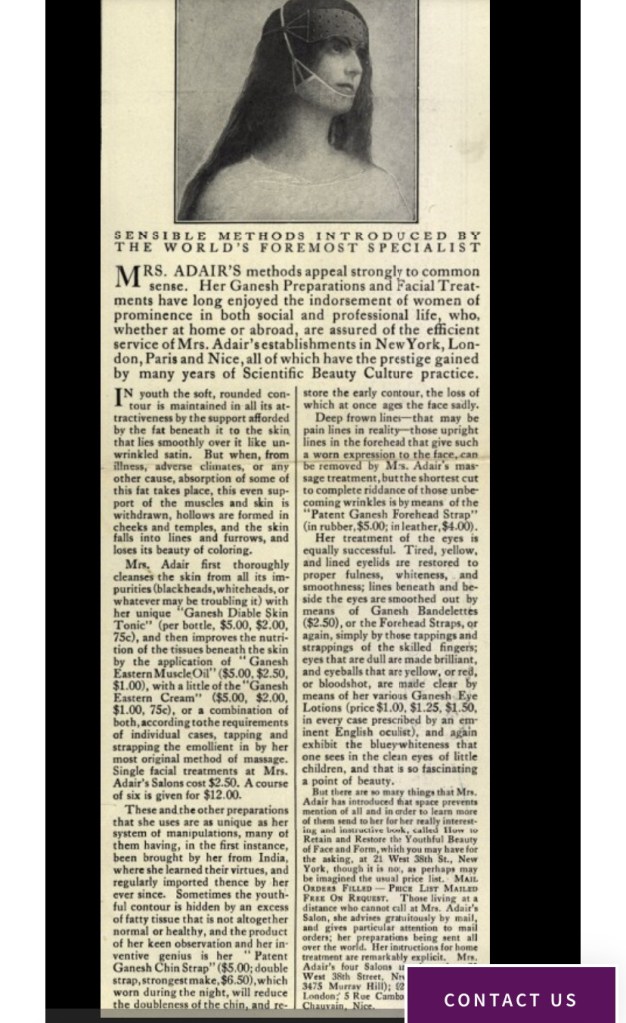
The ad is funny to me. Along with many other ads from this time period, it gets away with several half truths. The lack of transparency regarding what her methods actually accomplish allowed her to advertise more aggressively. Throughout the ad you can see where they’re trying to cement their integrity. “Sensible methods,” “common sense,” “indorsed by the masses,” are all examples of the buzz words they’re using. This is an example of “bandwagon appeal” and also “rational appeal.” She wants her product to seem popular and necessary to maintaining timely beauty standards. And according to what I’ve read, using the word indorsed in her ads instead of endorsed actually absolves Adair of liability. Indorsed is use more in legal contexts and it’s thought of a less strong word. Things like this matter because Adair goes as far as to claim that her products do things like “restoring youth.” Furthermore, what I mean by aggressively is that she advertised her products as fool proof. “If you have ugly or wrinkly skin, apply X on Y and you’ll have beautiful, full skin.” So she actively highlights insecurities people may have, and explains how her products will undoubtedly fix those insecurities. This is also known as “Less than perfect appeal,” according to the “What are Advertising Appeals” article. This is the targeted approach from Adair to make the reader feel like they need her products. One of the more modern parts of her ads are the inclusion of package based fees. Much like streaming packages today, she offered salon packages that would pay for six visits, at a slightly cheaper rate than one time visitors. Also there’s lots of ads for professional women, something the USA was opposed to at the time. Adair was a progressive, and later influenced her peers similarly.
Eleanor had a tumultuous few years in the early 1900s, full of setbacks. Like usual though, she turned her setbacks into strengths. Her first large setback was falling ill while on vacation to India with her new husband. She ended up not going with her group to see the Vale of Kashmir, but she found something better. Over the course of several days she learned many beauty secrets from the locals, and she would later come back with that exclusive knowledge. She claimed she invented Ganesh treatments, which no one could challenge. Electrolysis, weight reduction, facials, eye treatments, and massages were the main functions of her stores. She used Ganesh Muse Oil, Ganesh skin food, and Ganesh diable skin tonic. Her products sold between anywhere from 2$ for oils and topicals, to 5$ for her electrical forehead strap. She is hailed as a fashion icon, using her creativity and acquired knowledge to propel fashion to new heights. Her greatest achievement was not hers though, as she was the teacher of Elizabeth Arden, whose products are selling to this day.
The Canadian protégé of Adair was Elizabeth Arden, who was living in New York City when the dynamic duo linked for the first time. After dropping out of nursing school, she was sent away for failing expectations. She joined her brother in New York City where she acquired knowledge as a bookkeeper for the E.R. Squibb pharmaceutical company about beauty products. She soon started working under Eleanor Adair as a treatment girl, once again being an observant learner. Adair saw potential in her, and let her go work in Paris to gain experience in the fashion industry. When Arden returned, she quickly failed as a business owner in 1910, but tried again in 1912. And the rest is history.

This ad spoke to me because it is in Spanish, which is not a language Arden spoke. She spoke French and English. But this makeup set is in Spanish because her products have sold everywhere. Approximately 150 countries are still selling her products to this day. Also the ad is much more subtle, with less words and more proof of efficacy. The visual imagery in this newer ad makes it obvious you’re buying makeup, not war bonds. To this day, Arden’s influence in the makeup industry is unmatched, and has unrivaled longevity. She combined the practical science she learned from her first few jobs with the exclusive knowledge Adair passed to her to become a fashion tycoon. In 1962 due to her pioneering work in beauty, she received the Légion D’Honneur, the highest honor available from the French government.
Arden pulled from every facet of her career to become the fashion tycoon of the 1900s. She was a journalist, suffrage activist, fashion designer, and a scientist. Elizabeth Arden and Eleanor Adair used their extensive life experiences to propel each other into the strongest fashionistas of the 1900s. They did so through their ability to understand people, sell to them, but also deliver. According to the Nieman Reports article “Journalism Needs Leaders Who Know How to Run a Business”, the five reasons a journalists needs to know how to run a business are as follows.
- We need leaders who think like product managers
- We need leaders who can strategize
- We need leaders who are excited about entrepreneurship
- We need business leaders who can evangelize our mission
- We need leaders who consider themselves stewards
These women had all five of these qualities. And the world is still a better place for it.
 The Peanut Gallery
Leave a comment